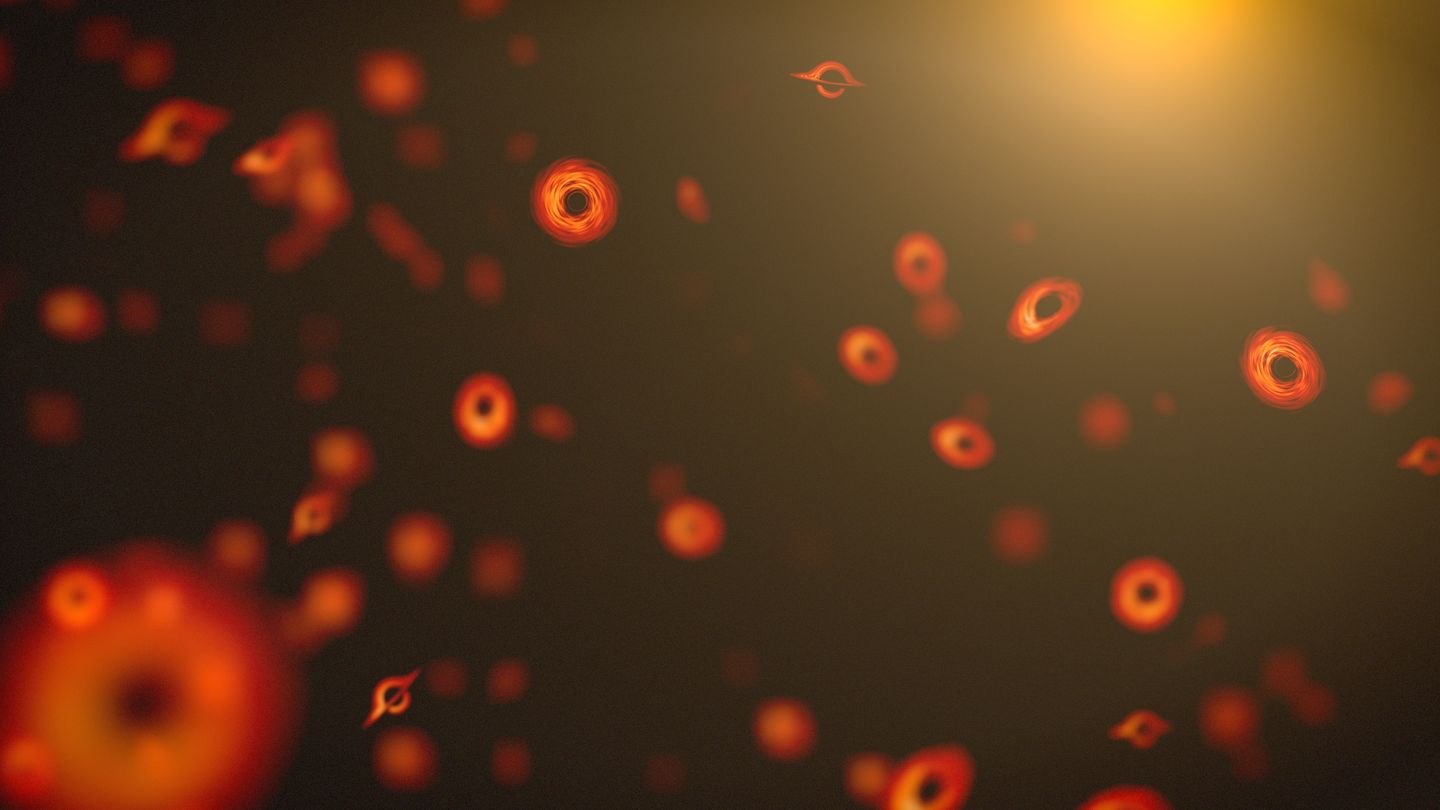
A new Astrophysical Journal paper lays out a possible way to look for one of cosmology’s long-running suspects: primordial black holes, hypothetical objects that may have formed in dense patches shortly after the Big Bang and may contribute to dark matter if they exist.
According to MIT News, the study asks what might happen if a surviving primordial black hole in the asteroid-mass range were captured by a modern star. The answer, in the researchers’ models, is not a single dramatic scenario but two possible branches. Under some conditions, the black hole could eventually form an accretion disk inside the star and drive an explosive disruption. Under other conditions, the paper says, the black hole could consume the star more quietly.
The work is theoretical. MIT News and the author manuscript describe analytic calculations, stellar evolution models, three-dimensional general-relativistic magnetohydrodynamic simulations, and Monte Carlo population synthesis. No primordial black hole was observed in this study.
One important result is about capture itself. MIT News says the team found a single star’s gravity would not be enough to trap a passing primordial black hole efficiently. Instead, the paper says capture is dominated by three-body interactions involving a companion such as another star or a planet. In that setup, repeated passages through stellar material can gradually shrink the black hole’s orbit until, over thousands to millions of years, it reaches the star’s center.
From there, the modeled evolution depends on how the system develops. MIT News describes one example in which, within several million years, the black hole would consume about 1 percent of the star’s mass. If the star has enough angular momentum at that stage, gas can pile up into a rotating disk around the black hole rather than falling straight in. The paper treats that disk-forming stage as the critical turning point: jets and outflows launched from the disk can disrupt the star on short timescales after disk formation.
MIT News says the predicted signal could include blue and ultraviolet light along with X-rays and gamma rays bright enough to be detectable with current telescopes. The author manuscript adds that radio emission could follow later, and that an X-ray flash or low-luminosity gamma-ray-burst-like signal depends on the jet escaping. The manuscript also cautions that the simulation is an early-time demonstration of disk-mediated feedback, not a converged calculation of the final jet or cocoon outcome.
That matters because the paper does not present a unique observational fingerprint. MIT News notes that other astrophysical phenomena could produce a similar flash, so any future detection would need supporting clues — for example, whether the exploding star’s properties are otherwise unexpected.
The paper, “The Life and Death of Stars that Capture Primordial Black Holes,” is listed in Crossref metadata as published online in The Astrophysical Journal on Nov. 19, 2026, with a print date of Nov. 20. The authors are Ore Gottlieb, Matteo Cantiello, Cameron Norton, Ken Van Tilburg, and Matthew Kleban. MIT News says the work was supported in part by the U.S. Department of Energy Office of Science Advanced Scientific Computing Research Program and the National Science Foundation.